
Responsible AI
Responsible AI starts with the choices we make
What AI is used for, where it runs, and who benefits from it are decisions we make as a software company. At ShhushAI, those decisions start with helping people find and manage work, then extend to the models, infrastructure, and data practices supporting that goal.

AI in service of human work
The people on our platforms create the value: their skills, ideas, experience, and services. We use AI to help connect that value with people who need it.
Our design goal is to reduce the effort of finding suitable opportunities and coordinating work. We are building around human participation, with technology supporting the connection between people.
Focused intelligence for defined tasks
Many AI products are thin layers over a frontier model, sending every request to a large general-purpose system in a remote GPU data center. AI is now the main driver of data-center electricity growth, and the IEA expects global data-center use to roughly double by 2030. Our core matching takes a different path.
Our core product AI uses compact models tuned around specific workflows, including understanding requests and helping match people with relevant work. We operate those models on our own infrastructure rather than depending on frontier-model APIs for the core matching process.
We choose the model and computing resources around the task. A focused matching workflow does not require us to build a general-purpose frontier model or operate the infrastructure needed to train one.
Source: IEA, Energy and AI (2025) and Key Questions on Energy and AI (2026) [4]
Infrastructure sized for the work
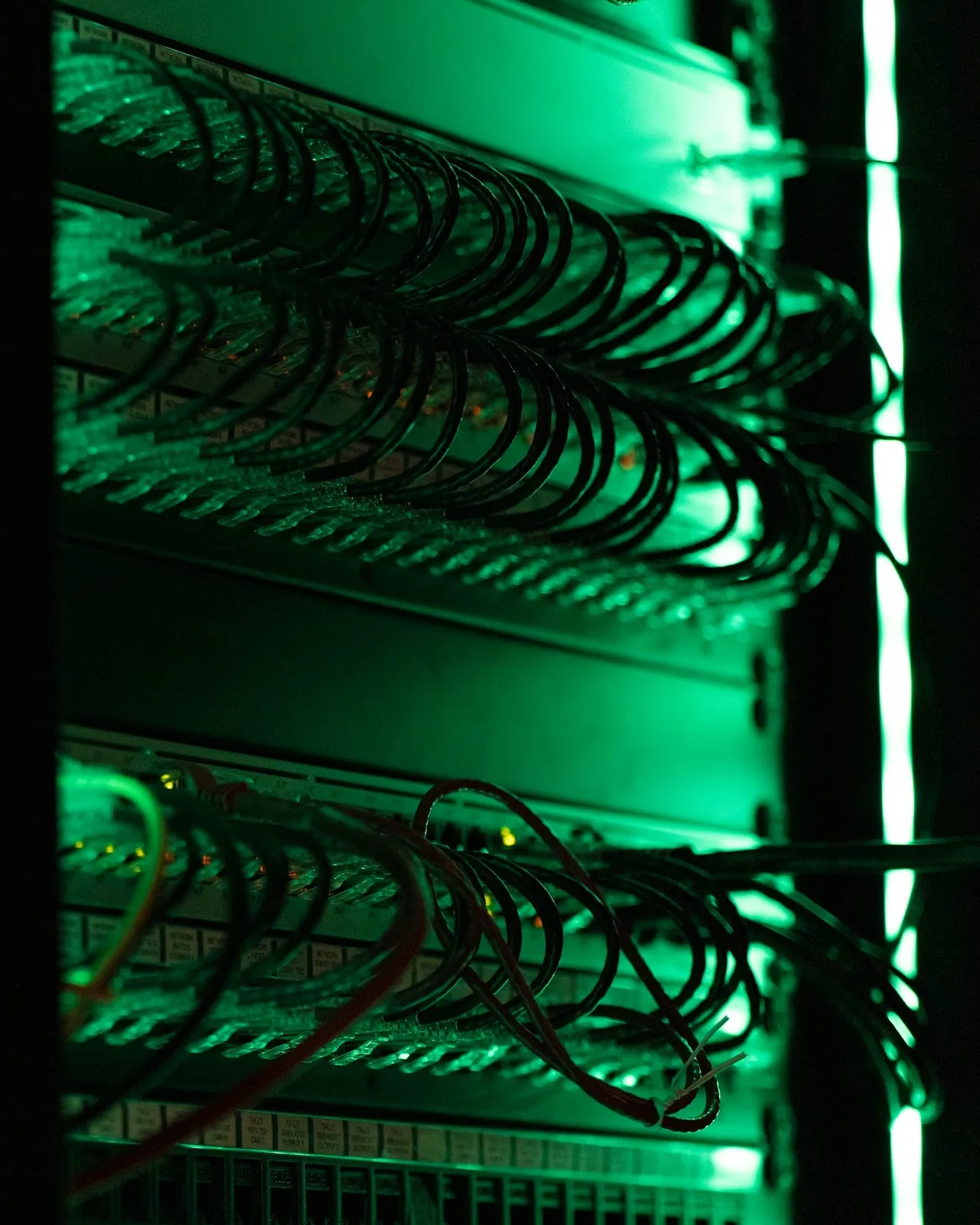
Our matching models run on conventional rack-mounted servers that draw approximately 700–800 watts each under load.
They fit comfortably within ordinary racks. In Uptime Institute’s 2026 survey, 69% of data-center operators said their most common rack runs under 10 kW. A single eight-GPU frontier-class AI server can exceed that on its own: NVIDIA rates its DGX B200 at up to 14.3 kW. The comparison below shows the difference in scale.
Sources: Uptime Institute Global Data Center Survey 2026 [3]; NVIDIA DGX B200 system guide [2]
The scale of the infrastructure we choose
ShhushAI servers (each)
0.7–0.8 kW700–800 W
Typical draw under load
Conventional rack servers running compact, task-tuned models
NVIDIA DGX H100
10.2 kW10,200 W
Manufacturer maximum rating [1]
Eight H100 GPUs; training and inference
NVIDIA DGX B200
14.3 kW14,300 W
Manufacturer maximum rating [2]
Eight B200 GPUs; training and inference
Privacy through deliberate design
Operating our models gives us direct control over where core AI processing happens and how data enters those workflows. Privacy also depends on what information a product collects, who can access it, and how long it is retained.
Self-hosted models are one part of that picture. Identity verification, payments, storage, and other supporting services have their own data flows and controls. Our approach is to make those choices deliberately and explain the relevant practices in each product’s privacy information.
Sources
- [1]NVIDIA DGX H100 and H200 system guide — power specifications
- [2]NVIDIA DGX B200 system guide — power specifications
- [3]Uptime Institute Global Data Center Survey 2026 — July 2026
- [4]IEA, Energy and AI (2025) and Key Questions on Energy and AI (2026)